


Mining and the many masks of gender violence : 16 days of activism in 2025
09/12/2025

Today women from South Africa and Zambia shared their lived experiences of working in communities where the devastating impact of mining has changed the lives of women irrevocably, and how they are fighting for justice.
Anglo American is a major global mining company with a long legacy and origins on the African continent. There is a public record of the contributions Anglo has made over the years, including bursaries and engineering training, enterprise development and educational support, in South Africa in particular. These efforts have undoubtedly helped young people gain qualifications, build careers, and open up opportunities that are often difficult to access outside of urban centres.
However, such efforts have been largely framed in Corporate Social Investment (CSI) terms which are devised by corporate employees sitting far from the realities of mining communities. The Anglo American Chairman’s Fund was widely admired for its philanthropy. But, post-1994 requirements for social plans around mining communities, BBB-EE initiatives to equalise opportunities for mining affected communities, and social impact programmes have largely failed on all metrics which matter – deep transformation of the damage caused by the mining industry. The social ills arising from mining operations, laid down over a century ago, continue to manifest across South and Southern Africa today, not least in the lives of women.
Women’s voices remain absent from decision making fora, and such initiatives being announced in 2025 as part of the 16 days of activism against Gender Based Violence fall far short of transformational investments needed for real change. For instance, Tshikululu Social Investments (TSI) recently shared news of supporting 20,000 women with Valterra Platinum (previously owned by Anglo), quoting a study by women affected by mining (WAMUA) highlighting that in mining communities 56% of women reported experience of GBV or know of someone close to them who has. TSI said the aim of the partnership is to ‘strengthen the GBV response in mining communities’ as though the prevalence of GBV in mining areas is unrelated to the industry – when in fact it correlates to the conditions which the industry itself created.
Whether those conditions are overuse of local water (most recently in the production of so called ‘green’ hydrogen), environmental damage through tailing mountains left behind, as in Kabwe (Zambia), or the devastation caused to families by early deaths among former miners, which Justice for Miners, a South African NGO, highlights in their film ‘Dying for Gold’, it is institutionally created violence disadvantaging Black women.
Leaving aside the acid water table scandal, which affects whole regions in South Africa, the sites of damage from mining operations are so numerous that in South Africa we’ve largely forgotten that solutions exist – and the failure by governments to hold mining companies to fully account and remedy sites has now fallen to communities themselves. WAMUA, Women Affected by Mining United in Action, is one example of such a movement of people working for justice across South Africa. Justice for Miners, a regional movement, is doing the same for widows and children left destitute by lack of compensation for the deaths of their husbands and fathers.
The masking or denial of responsibility continues to keep the realities of mining covered up. Catherine Myerburg said today “if the true cost of mining were calculated, companies like Anglo wouldn’t make a profit. Instead the price is paid by workers and their families”.
Herein lies the central contradiction, alongside the lived reality of thousands of marginalised people affected by the neglect, denial, and punching down of Anglo and many other large mining corporations: the dis-connect between philanthropic or corporate social investment budgets and the scale of the problems caused by mining can no longer be ignored.
As an example, consider Tshikululu’s announcement of its ‘coordinated survivor centred response’: quoting that study conducted by WAMUA In 14 communities (2024) as the base for its initiative, Tshikululu does not reveal the extent of the cash investment or the community organisations it has funded. You can bet a few million rand that the investment does not match their claim of supporting ‘Valterra Platinum in building safer, more resilient mining communities and strengthening the ecosystem that supports survivors’. Note how the narrative ensures communities remain passive in the gaze of the company doing the building. Meanwhile, the company gets to claim its commitment to ‘coordinated and accountable social investment [that] can transform lives’. To whom is Valterra accountable in this context? Time and again, no matter which particular mining community you review, you find the same imbalance between communities and company beneficiaries.
Justice for Miners Eastern Cape chapter leader Ziyanda Manjati said “Most of the miners have to leave their families, their wives and children, at a young age and didn’t have the chance to go to school. So 90% of them are not educated. So life after mining leads to a lot of problems. Many men have returned to their families but are incapacitated by TB, silicosis or mining injuries. This can lead to stress and gender-based violence especially with loss of dignity and inability to work. The wife has to take care of the men, who are sick, as well as support the whole family. The husband may have been away for a decade but often comes back without any money and are sick.”

The 2025 Campaign for 16 Days of Activism for No Violence Against Women and Children, provides a moment in which this contradiction must begin to be fundamentally challenged.
Anglo American publicly positions itself as a leader in gender-based violence prevention. The company repeatedly issues public commitments on the subject. Anglo’s own statements include:
“To mark the start of 16 Days of Activism, we’re launching our Living With Dignity Programme, focusing on gender-based violence.”
“We aim to create safe workplaces, safe homes, safe schools and safe communities in the regions we operate in.”
(Mining Review Africa)
Anglo further states:
“We have extended our efforts to combat GBV and harassment beyond the mine gate because we believe we can only sustain meaningful change inside the business by tackling the root causes in homes, schools and communities.” – Hermien Botes, Head of Sustainability Engagement, Anglo American.
And in official company announcements:
“Anglo American is committing to addressing GBV at its roots.”
“Our Living with Dignity framework is rooted in a strong commitment to eradicating gender-based violence both within the organisation and outside the fence.”
– Marcel Korth, Principal: Living with Dignity / GBV, Anglo American (link here)
Anik Michaud, Group Director of Corporate Relations at Anglo American, said: “Accelerating our commitment to the global fight against gender-based violence through our WeCare lives and livelihoods response programme could not be more appropriate, as many more women and children need safe spaces. If we do not act, we risk leaving countless more women and children in harm’s way. We are pleased to be working with a range of organisations who are providing access to support and shelter to those women and children who are most vulnerable during this time. Our operations and host communities operate as an ecosystem and both must be healthy to prosper.”
These are strong, public, values-based commitments. No one disputes that such programmes are important. But review the language: it points to the GBV ‘crisis’ as ‘out there’ in homes, schools and communities; whereas the fundamental systemic injustices perpetrated by mining companies over decades are at the root cause of the devastation to families up and down South Africa. This is mask one – ‘it’s not us, it’s them’.
The work by Justice for Miners, including in their award-winning documentary film ‘Dying for Gold’ illustrates this point so clearly that it’s hard to see why mining companies, and governments, remain blind to the scale of repair and reparations needed. Perhaps the sheer enormity of the colonial and apartheid damage seems too far in the past. But the reality of a lack of corporate ‘truth and reconciliation’ in the mining sector is lived by poor people, especially women, every single day.
Let’s consider another case, this time in Zambia, at the Kabwe mine (formerly known as ‘Broken Hill’).
Approximately 140,000 children and women in Kabwe, Zambia are part of a class-action legal case where catastrophic lead poisoning is linked to Anglo American’s historic mining operations. Scientific assessments show:
- severe cognitive impairment in children;
- neurological damage;
- stunted growth and mobility difficulties;
- pregnancy complications;
- intergenerational health risks – including premature death.

These harms directly affect women’s bodies, women’s caregiving responsibilities, and children’s long-term development. This environmental harm to women is also gender-based violence. For any organisation to claim it is “addressing GBV at the roots” while simultaneously contesting responsibility for women and children harmed by its own historic operations creates a visible and deeply troubling contradiction, one that produces enduring violence in different forms. The denial of responsibility is perhaps the most pernicious: whereas archive documents show clearly the board members of the mine were Anglo American employees and appointees, Anglo simply deny they were either owners or operators at the mine, and in any case, because the mine was nationalised in 1974, they produce mask two: ‘it wasn’t us, it was the locals who came after us’. This approach leaves women and children who are forced to live around the mine with no recourse for repair or justice. Anglo refuse to accept that a South African court hearing all the evidence, on an equal footing with the community, is a fair process. An appeal hearing at the South African Supreme Court last month is considering if the class action should be allowed. If the case is dismissed, once again women and children will have to live with the environmental violence on their bodies and minds, for generations to come.
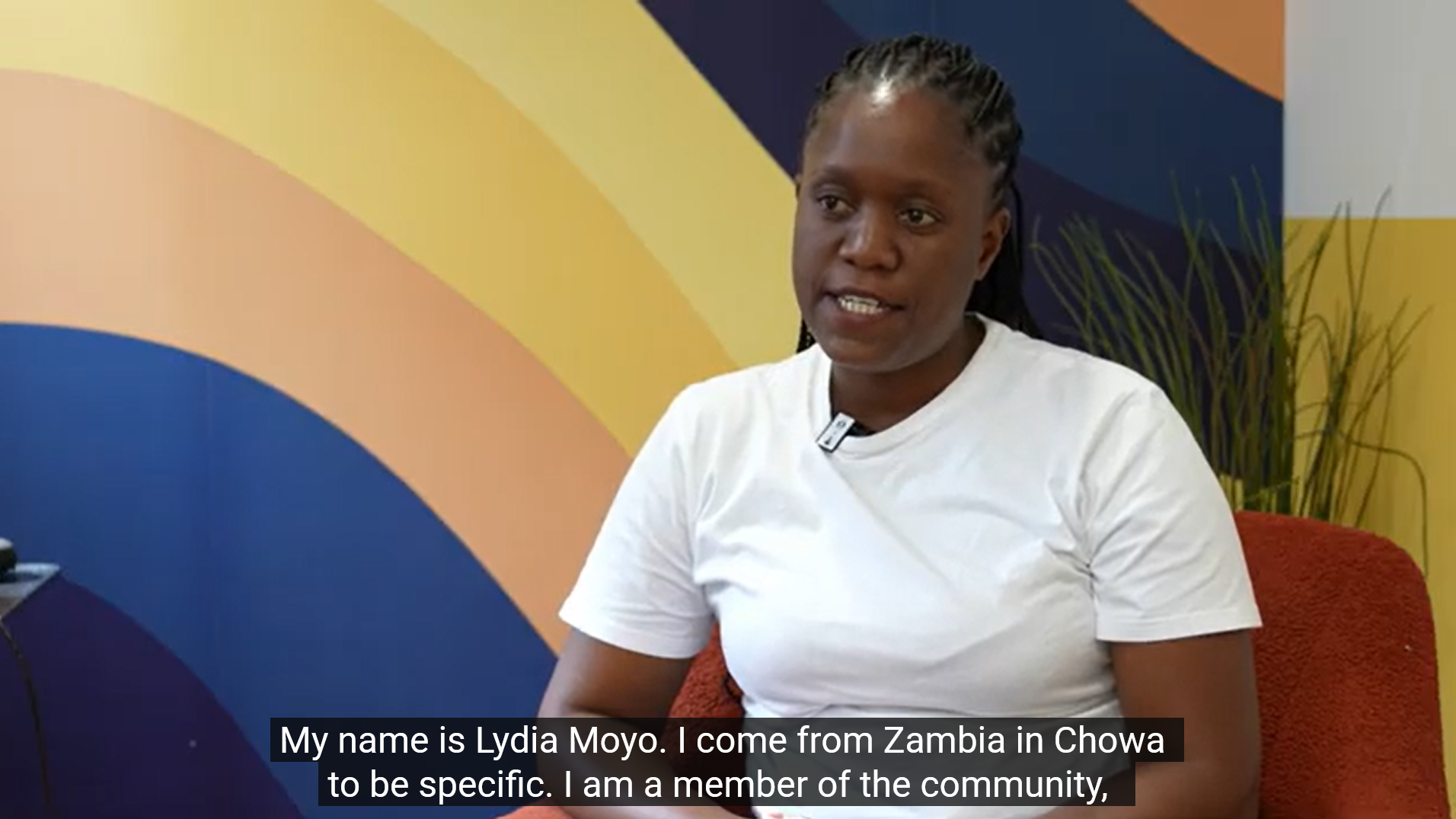
Lydia Moyo, community advocate in Kabwe said: “In my community a lot of women are affected – pregnant women face a high risk of miscarriage and children suffer from low performance in school because of the presence of lead and they are not able to retain information. It is very important that the situation that is currently happening in Kabwe, does not happen in South Africa, where Anglo is allowed to exit without taking due care of the impact of its mining activities.”
Anglo continues attempts (with its large public relations budgets) to discredit the Kabwe case by attacking the motives of the advocacy groups involved. Anglo’s public relations responses have also extended to questioning the motives of civil-society partners who recently launched a petition to the Parliament of South Africa calling for Anglo’s accountability. Such attacks on community organisations are really an assault on truth-seeking. In the case of Kabwe, If Anglo has nothing to hide, why not show up as a responsible citizen in court and let the law decide?
Anglo’s framing diverts attention from the core issues: that children, women and communities are suffering, and places the burden of justification on those with the least access, forcing them to defend their credibility against a far more powerful institution.
Like many mining corporations, Anglo calls for “gender-based violence prevention.” Yet for affected children and women living under the long shadow cast by extractive negligence, Anglo’s GBV messaging is experienced as denialism and scapegoating. This dynamic is now widely recognised as gaslighting: a form of psychological abuse, emotional violence, and power or coercive control.
If Anglo is sincere in wanting to “address GBV at its roots,” then it must acknowledge that environmental poisoning, societal harm and health issues are themselves root cause of gendered harm.
Women raising sick children endure long-term fear, emotional stress, financial pressure, and social shame; these are all recognised contributors to conditions that increase vulnerability to violence and exploitation.
Thousands of children and women across Africa face these barriers. Many have limited financial resources, limited access to expert legal teams, face political and institutional obstacles, and risk ostracization at home, school, or work.
Refilwe Mofokeng, from WAMUA said today “Anglo American can’t avoid accountability by changing their postcode’. Women are being left without any support. Women are vulnerable and coping with a lot. That’s the reality in mining affected communities. We need each other to hold these mining companies accountable.”
These are the power dynamics that benefit powerful corporations, and in which Anglo rolls out its own GBV communications and legal approaches. For women living in mining-affected areas, this echoes familiar patterns of discrimination, inequality, and institutional resistance. Those affected struggle for acknowledgement while the more powerful party denies responsibility: a behavioural pattern extensively described in GBV research. In the case of communities in Peru and Chile, this same gaslighting occurs. At Anglo’s AGM in London earlier this year, community questions were batted away with ‘it’s not us and you can’t prove otherwise’. What is in the mind of Anglo leadership, when people leave their homes thousands of miles away, to try to be heard at a corporate AGM because company representatives are not engaging in the mining community they come from? This is a form of violence, not limited to women, but to those who are rendered invisible by the power of multi-national entities who consider their operations, their ‘vision’, and their profits to be superior to the needs of indigenous communities.
Perhaps this points to a broader pattern. Anglo’s public-relations and corporate-communications strategies, sustained over decades, have often minimised or reframed the realities faced by affected communities. In practice, this has created a century-long form of gaslighting on us all, subtle at times and overt at others, that operates as a kind of collective psychological abuse.
Make no mistake, this collective damage underpins the kind of world we are leaving to the next generation. How can we work more effectively, locally and internationally in solidarity, to end the ‘cycle of abuse’ of corporate culture in mining? And, who will help fund it in proportion to the need?
Read more about the facilitators and roots of GBV and the work of community movements and groups who need our support for fundamental change: