


Athol Williams, South African academic, professor and whistleblower, speaks at the opening of the Norman Kaplan exhibition about the South African artist’s anti-apartheid and post-1994 art. This exhibition took place at Ovada Gallery, Oxford, in July 2025, and was organised by Action for Southern Africa (ACTSA) and Centre for Memory and Learning (CML). Athol Williams was recently made Oxford University’s first Business Poet Laureate. Find out more about his poetry here: https://www.atholwilliams.com/poetry
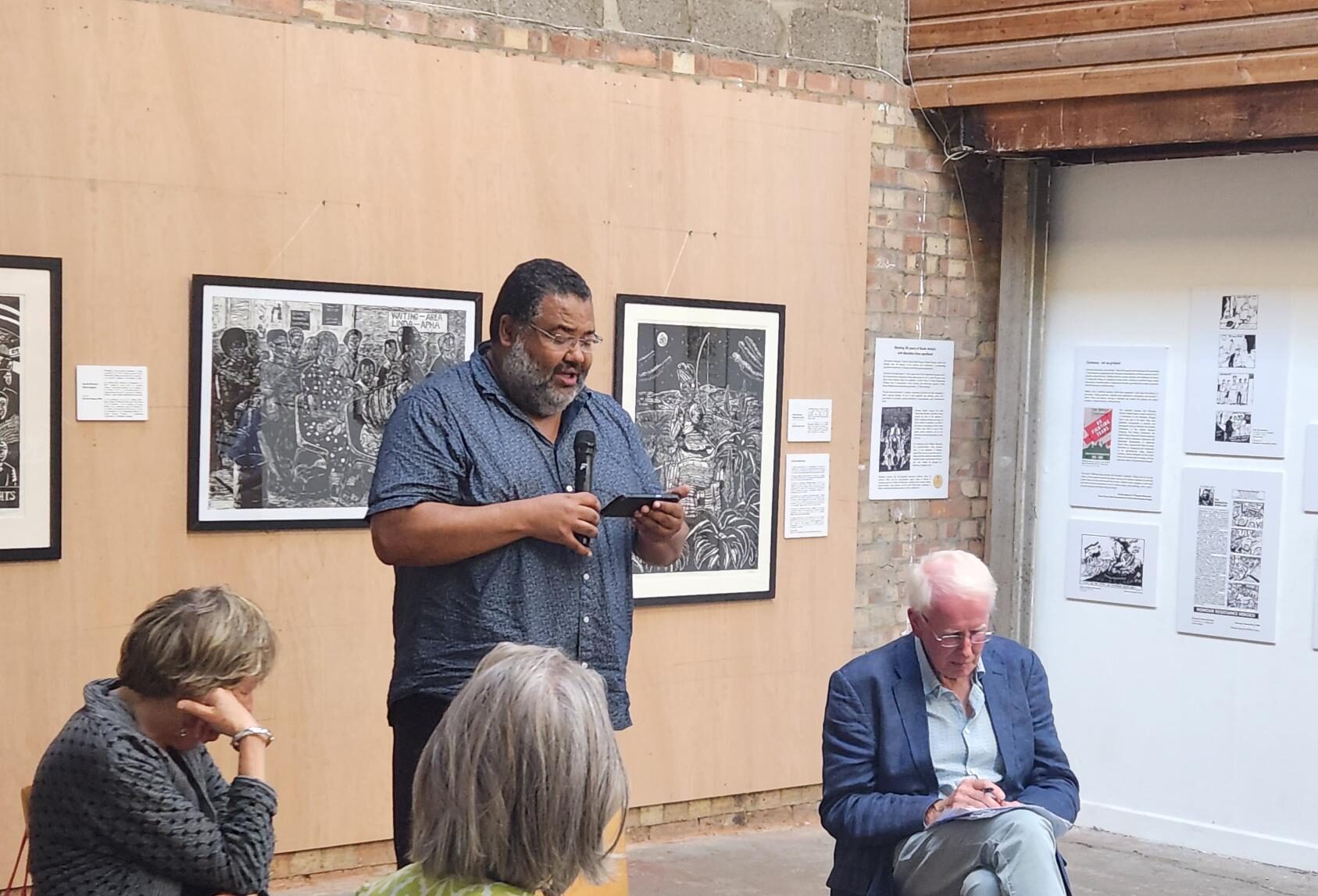
“I’m Athol, I’m from Cape Town in South Africa and for the first 24 years of my life what everyone knows about the realities of life under apartheid, I lived through every day.
At the age of 15 I strangely didn’t play cricket or soccer, I played baseball and was selected for the national baseball team. I couldn’t understand why I didn’t get a Springbok jersey for being a South African national and someone explained to me that as a colored child – as I was then classified – I couldn’t play for the Springboks. I wasn’t a real South African.
Growing up, my schooling was separate from the schooling of white children. Mine was designed to make me a factory worker or a laborer. My mother and her family grew up in District Six and in 1966 the apartheid government decided every person of color had to be removed. My mother’s family got dumped in an area called Mitchells Plain which was just a bunch of dunes, one road in – one road out. Today there are a million people and 50 primary schools now in this ghetto where I grew up.
Everything around me told me I was a second class citizen because of apartheid. The beaches I could go to were defined by color, the restaurants I could go to, the universities I could go to, the schools I could go to, the jobs I could go to, who I could date, was defined by law. The immorality act said if I dated a white woman it would be punishable by imprisonment for both myself and for her.
I had some of the cliche experiences, like boarding a bus in Johannesburg without realising it was white-only. To take those three or four steps down back out slowly breaks something within you as a young person, believing in your possibility, believing what life holds, but having to face that indignity.
Because of education being such an act of deprivation and oppression, I responded and probably overshot in my response by earning seven university degrees but in that process I then became marked as an enemy and so even at Wits University, my dormitory room got invaded by the police and I was beaten up just because.
So when Nelson Mandela was released in 1990, I’d never seen pictures of him and yet I marched #Free Nelson Mandela#. There was such a sense of innocence and optimism.
So fast forward from that point to November 2021 where I packed a bag and left South Africa under threat for my life and came to the UK alone, without my family, without anyone knowing, in hiding – because eight months earlier I’d taken the decision to publicly expose the corruption and state capture I’d witnessed in South Africa.
So there was this widespread attack on South Africa’s democratic institutions. And so for me it wasn’t just being a whistleblower – it was continuing the work of Nelson Mandela and Walter Sisulu and Oliver Tambo of freeing our country from capture, from oppression and I felt I was continuing that work with the way I was doing it. it in my own way. I testified at the Zondo Commission for two full days and produced 700 pages of evidence showing the massive network of corruption that tried to bring down South Africa’s institutions and looted billions and billions. The plan was to disable, across the entire government, the oversight abilities in our government so people can come at will and loot and do whatever they wanted.
At the end, the Chief Justice Officer of South Africa who oversaw the commission wrote his report acknowledging the key role I played in linking former President Zuma to political parties and then to many multinational corporations and thanked me for refusing the large sums of money I was offered for my silence.
But within a few months of me, a fellow whistleblower got assassinated outside her home. I began getting threats and warnings. There was enough credible evidence to say that people were trying to assassinate me. And so I decided to leave the country, the very country that I had given everything for to support these institutions.
But that isn’t the tragedy. The tragedy for me was the fact that the South African government wouldn’t support me, wouldn’t protect me.
And so I want to read a short poem by which I want to offer an explanation of what’s gone wrong and what’s gone on in South Africa. It’s called Code of Ethics.
I’ve got a family to feed.
I’m just doing what anyone in my position would do.
I deserve this. It is owed to me.
Besides, if they can do it, why shouldn’t I?
I’m just doing what anyone in my position would do.
After all, I deserve this.
It is owed to me.
If they can do it, why shouldn’t I?
I’ve also got a family to feed.
I deserve this.
It is owed to me.
So, if they can do it, why shouldn’t I? I’ve got a family to feed.
And I’m just doing what anyone in my position will do.
If they can do it, why shouldn’t I?
I’ve got a family to feed.
And I’m just doing what anyone in my position would do.
I deserve this. It is owed to me.
Within that poem, there’s obviously four lines, repeated. I believe these are four of the justifications of evil that man dreams up.
The one is, I’m not committing this evil for myself. It’s for others. It’s for a greater good. Right? What’s happening in South Africa now there’s a sense of self-entitlement or greed among some who are saying I’ve got a family to feed and so I’ll steal, I’ll loot, I’ll commit these crimes because I suffered many years of apartheid so therefore it’s owed to me and so I can rightfully steal.
Another justification of evil is, if they can do it why shouldn’t I, and that’s going on a lot with ‘well the white party leaders stole – why shouldn’t we?’ or now it goes to ‘Some of those senior black leaders are stealing – why I shouldn’t I?’
And lastly, this idea of ‘well, if you were in my position, you’d do the same thing, right? I think in South Africa, we are saying, we all suffered many times and so we should carry on this corruption. And so that’s partly what’s justifying this behaviour.
So I lost my job as a senior lecturer at the University of Cape Town because I had taken this ethical stand. My mental health deteriorated because basically in South Africa I was treated as though I’d done something wrong. Think about how we teach our children. You do good, you get rewarded. You do bad, you get punished. Well, I was getting punished. So, obviously the truth was something bad in my society.
We must celebrate the fall of apartheid. But I think we must keep focusing on the human rights of people there right now that are being denied systematically. So I’ll close with this poem and it’s a poem of celebration – because that’s what keeps me going. I continue as many of us continue, in the belief that that South Africa we dreamed of, that South Africa, that I dreamed of as a 20-year-old, is still there. It’s still waiting for us. But it requires people to act and to do something about it. So this poem is called ‘A new South African story’.
Let’s tell a new story. A new South African story.
Let it stampede down the streets , gallop across open fields,
Tumble into gardens, through gateways, and swing from branch to wire,
And trickle its way down columns and pillars of power.
A story not of having more and pressing down, but taking less and lifting up.
A story of many streams flowing into one new river.
A story of bringing us hope, that brings us joy,
That gets us to our feet,
That makes the sun shine even in the deepest darkness of the coldest winter.
A story that lifts our eyes to the heavens,
that makes our hearts somersault, our spirits gyrate in delight.
Even if crooked in grammar, or spoken with twisted words, or commas and capitals that strangle the verbs, let’s tell our story.
In hip-hop, poem or prose, foreign or mother tongue, on paper or flag, from rooftop hung, let’s tell this story.
This new freedom story, that bursts through the walls inside,
As the cries of our fathers and the songs of our mothers,
rumble in our veins,
The story tired of waiting, that needs to be told,
That needs to flow, that needs to pour, that needs to rise,
To fill the emptiness that others have made and seek to hold,
A story that reminds us that we are whole, a people with standing,
a people with dreams, a people with stories.
Let’s flood the roads of greed and the highways of hatred with this new story.
Let’s pour it into the damns, into the lakes, let’s top up the streams and springs, pipe it into the fountains, channel it to the oceans and speak it to the clouds,
So that when it rains, our dream that people are people through other people pours in torrents,
That we may be free, our hearts unchained.
That we live as one, the walls torn down.
That we eat together, our plates all filled.
That we may become a great new nation.
Let’s tell this story, this new South Africa story.