


UBI in South Africa: Unlocking True Prosperity
28/01/2026
On 28th January ACTSA was delighted collaborate with South African partners Amandla Mobi and Oxfam South Africa on a new report about the potential of a Universal Basic Income (UBI) in South Africa and why new research around the ‘multiplier effect’ shows how it could be a gamechanger for the nation.
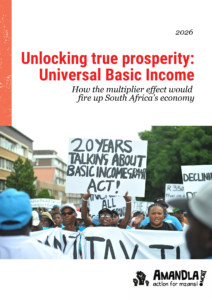
Read the report here.
Now is the time for a UBI in South Africa. Why? The statistics that illustrate the breadth and depth of poverty and inequality in South Africa are repeated without any sense of the magnitude of the crisis they describe. It’s enough to remember that according to the 2025 Poverty Trends report of StatsSA, 66% of people in South Africa fall below the Upper Bound Poverty Line. We have the highest wealth and income inequality in the world, and one of the highest unemployment rates. Black women carry the heaviest burden, disproportionately affected by unemployment and low pay, with female-headed households poorer than male-headed ones.
High levels of precarious and informal work and piece jobs characterise what work is available for many millions – particularly women – counted as employed by the employment surveys. The vulnerability of the poor and the working poor not only affects their quality of life, but also has a direct impact on the low GDP growth. Low growth affects a number of macroeconomic dynamics, and this has led to the country’s negative growth cycle.
Successive governments have failed to stem economic stagnation. This has been the excuse for not implementing the constitutional guarantee to social security for all in need, because of ‘affordability’. However, assessing the scenarios for UBI as an economic catalyst have not been rigorously examined or debated outside elite circles of political and organised business fora. That needs to change.
We need something different, created for our specific national needs and challenges. More and more research is showing the extent to which a UBI, unlike the meagre amount of current grants, can act as an investment, which – implemented properly – can stimulate the economy. We call that economic stimulus ‘the multiplier effect’, which refers to how government investment into social security budget (or public services) is actually multiplied. This report outlines how such a multiplier can work in our economy, applying groundbreaking research from Brazil by Dante Cardoso.
UBI is a stimulus that happens through every person. As the money is received by all, it provides a huge boost to consumption, helps people create jobs and set up businesses that other people can now support with their UBI, supports children through improved school attendance or young people’s training. It is financial inclusion from the get-go – injecting money into every home, village, town, region via the secure purchasing of basic needs every month. The effectiveness of UBI is evidenced in dozens of successful pilot programmes worldwide.
Several factors make South Africa perfectly positioned to implement a UBI and a growing coalition is arguing that it would not only transform how people grapple with poverty and inequality and meet the state’s Constitutional obligations, but would also act as an economic stimulus to kickstart the economy out of years of stagnation and so increase economic growth, which Treasury’s current policies of austerity have failed to do.
This report provides a basis for dialogue, determination and delivery of a UBI for South Africa. It explains how, if implemented, all people will benefit immediately from UBI injecting the necessary income into households that the current Social Relief of Distress grant fails to do.