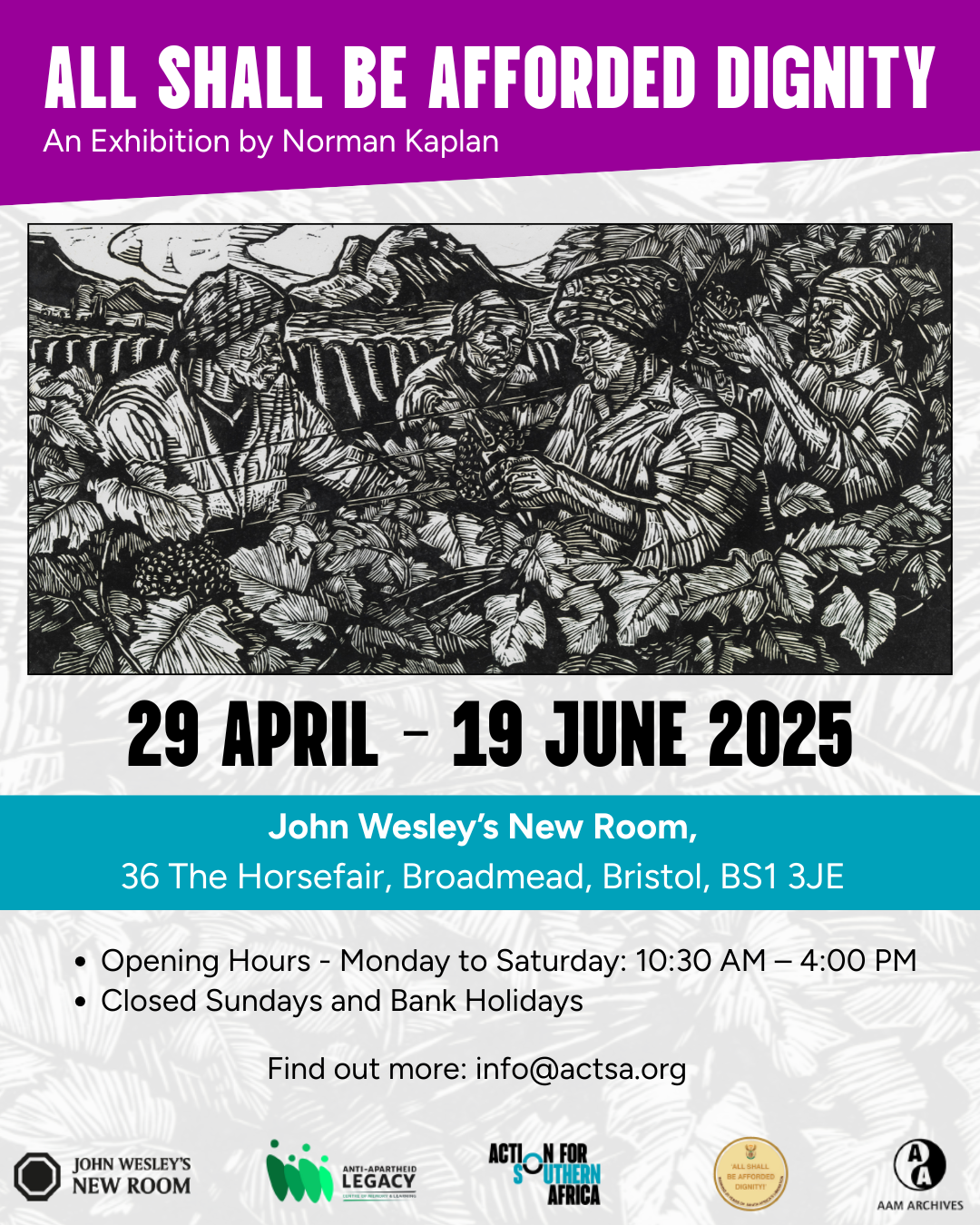
All Shall Be Afforded Dignity – Bristol
Tue 29 Apr - Thu 19 Jun
John Wesley’s New Room, 36 The Horsefair, Broadmead, Bristol, BS1 3JE
About the exhibition: All Shall Be Afforded Dignity
This exhibition celebrates how a movement of ordinary people across the world responded to a clear injustice of legalised racism, joining those South Africans leading the demand for equality and dignity for all. In the UK, the British Anti-Apartheid Movement was one of those leading action against racism.
As ACTSA’s 30th anniversary year opens, we reflect on how, as the successor organisation in the UK, we continue that work to strengthen social justice in the region and sustain the idea of international solidarity through shared actions for democracy, human rights, and peace.
Dignity is a universal theme. Achieving a state where no one is left behind requires sustained solidarity and dialogue as well as legislation and policy for every citizen of the world. This exhibition provides a space for reflection and remembrance, appreciation, and future action—to be part of the global community seeking a common goal: the fulfilment of the promise of the UN Declaration of Human Rights across Southern Africa.
“All Shall Be Afforded Dignity” is organised around the work (of the same name) that artist Norman Kaplan made in 1996 in response to a call for art to respond to the ‘home’ of the Constitution of newly democratic South Africa. His lino-cut, All shall Be Afforded Dignity, was awarded the first prize honour to be engraved into a window for permanent presence in the South African Constitutional Court.
Exhibiting (lino-)prints and cartoons created by the artist, whilst living in apartheid-South Africa, as an artist in exile in the UK to support the liberation movement, and as a response to the hope offered by a new South Africa, the exhibition weaves a narrative that explores the interconnected themes of dignity, democracy, and the enduring human spirit.
The artist: Norman Kaplan (b: 1947)
Norman is a South African of Russian Jewish heritage. His lived-experience of, and solidarity with, the effects of the stratification of race under apartheid, is articulated through his public facing print making and, in the cartoons, and design work created for the liberation movement, including clandestine cartoons and false covers to avoid apartheid-censors created for political publications and public awareness raising materials created for advocacy vehicle the International Defence and Aid Fund. The exhibition brings together works from both of these strands of Kaplan’s artistry, speaking to the power of collaboration, solidarity, and art as a tool of struggle to create awareness and change, paving the way for widespread acceptance and understanding of the value of human rights and implementation of change towards true freedom and equality for all.
Kaplans prints and cartoons encapsulate values integral to the young democratic nation’s ethos, resonating not only with the ongoing journey towards a better post-apartheid South Africa but also advocating for a global commitment to universal dignity and respect for human rights.
The exhibition delves into the accessible methods of drawing and lino-printing employed by Kaplan, recognising these techniques as tools of struggle, change, and resilience. From the never publicly displayed cartoons created in exile by Kaplan for The African Communist and the ANC’s Sechaba whilst to his more publicly known works, including some from the Constitutional Court’s collection, Kaplan’s art stands as a testament to the enduring power of creativity in the face of adversity, emphasising its role as a potent force for social transformation. His art serves as a potent storyteller of human rights struggles, inviting viewers to reflect on the shared human experience, fostering awareness and empathy.
“All Shall Be Afforded Dignity” transcends mere retrospective celebration; it emerges as a dynamic forum for reflection on the values propelling societal progress. Kaplan’s art offers as a bridge connecting historical struggles to contemporary aspirations, urging contemplation on the relevance of accessible artistic methods as instruments of positive change, not only in South Africa but in the collective pursuit of a better world for all. In a global context where individuals grapple with the denial of their inherent rights, the exhibition inspires hope for a future where dignity universally prevails.
To become involved in the work of Action for Southern Africa, working with civil society across the UK and the Southern Africa region, email us: [email protected]
Venue Information:
John Wesley’s New Room, 36 The Horsefair, Bristol, BS1 3JE
Free admission – on display in The Chapel
Monday – Saturday, 10:30am – 4pm
Closed Bank Holiday Mondays
Access
The exhibition will be displayed on the ground floor of the Chapel. This is fully accessible, reached from both the Broadmead and Horsefair entrances (although please note that there is no disabled access to the chapel gallery due to the 18th century stairs). For more information about access (including Accessibility Guide and a Visual Story) please visit the New Room Website Accessibility Page.
For more information about visiting John Wesley’s New Room, including nearest transport links, see the New Room Website Visit Us Page.