


Anglo American questioned by affected mother at its AGM
27/05/2025

“What is stopping you from turning your attention towards the ongoing suffering of the people of Kabwe, to keep the promise of your own promises to remedy where you have done harm, and to do no harm?”
On Wednesday 30 April, the Anglo American AGM (Annual General Meeting) took place. ACTSA invited mother and community advocate Lydia to come over from Kabwe, Zambia in order to attend. Using a shareholder spot, Lydia asked a question about the decades of lead pollution affecting children like hers and the wider community in Kabwe due to the contamination Anglo American left behind from its 49-year large lead and zinc mine.
Lydia’s question at the AGM:
“My name is Lydia Moyo, I’m here as proxy shareholder. I am the mother of two girls, under 12 years of age, who live in one of the villages in Kabwe, Zambia, to be specific. We are affected by the so-called ‘black mountain’ dust, by the lead poisoning arising from the canal built by Anglo American. This canal was built as a disposal for mining waste and much of our soil and water is contaminated, and it’s really making it difficult for us to grow vegetables and even our staple, maize. Given that Anglo American South Africa knew about children’s death from lead poisoning back in the late 1960s, what is stopping you from turning your attention towards the ongoing suffering of the people of Kabwe, to keep the promise of your own promises to remedy where you have done harm, and to do no harm? You may be gone in Zambia, for now, but we see you are in Chile, Peru and you are doing the same thing that you did to Kabwe 50 years ago. And lastly I also want to find out why you are contesting the ongoing legal case of Kabwe.”
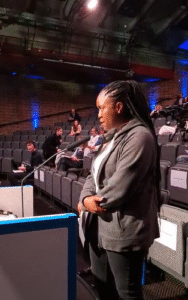
The response to Ms Moyo from Anglo American’s Richard Price started with “I don’t really mean anything by this, but if I could just clarify one thing, I understand that you may have acted as a paralegal in the past for the two law firms that have brought this class action suit against us; are you here in that capacity or are you here in your personal capacity?”
Ms Moyo had already said she was there as a proxy shareholder and as a mother and resident of Kabwe, in her own introduction. Ms Moyo experienced this deliberate singling out for questioning her capacity in attending the AGM as an attempt to undermine her lived experience and rather paint her attendance at the AGM as something other than it was.
Public documents submitted to the court in South Africa acknowledge that, in 2020 and in 2022, Ms Moyo had occasionally assisted the case lawyers, Mbuyisa Moleele Attorneys, with paralegal community work including language interpretation and other tasks such as organising meetings or interviews. Ms Moyo may do so again in the future. Anglo American already knew that information.
Why then seek to undermine Ms Moyo in public, as if assisting with paralegal duties – as is very common in such cases – affects her ability to speak about what her community and her children are going through? This occasional assistance does not detract from the claimants’ quest for accountability for the widespread pollution that they hold Anglo American responsible for, something which is yet to be tested in a class action hearing.
Mr Price later responded to another questioner about the moral case of Anglo American with respect to Kabwe. He said “It’s a fair question, right, I mean the Johannesburg High Court, did not dismiss this claim based on some, you know, some legal technicality, like where you might say, ‘not withstanding that legal technicality there is still a moral responsibility for Anglo American to address this situation’. The court examined, and I was there for a few days of the trial, and all the evidence was presented to the court and it had a relatively low bar deciding whether or not it was in the interests of justice to allow the case to proceed, and it chose not to, it found it was not in the interests of justice for this case to proceed, because of, you know, serious factual and legal flaws in the claimants arguments and that goes to moral responsibility as well”.
This statement is incorrect in fact and context. There has been no trial, because the class action is still awaiting certification, something which Anglo American continues to obstruct even though the high court judge agreed that this route is the community’s only means to access justice. Because there has been no trial, all the evidence has not been examined, despite Mr Price implying above, and earlier in the meeting saying “hundreds of pages of evidence were submitted to the court”. The context it is missing is that the Kabwe claimants’ right to appeal was granted by the same judge who acknowledged it had multiple grounds to do so on.
Mr Price closed with “As far as we are concerned, we are not responsible for the situation in Kabwe is in today. Yes we did have an interest in that mine 50-100 years ago, but that mine was operated for another 20 years, by someone else who was responsible for the remediation at the time. Our period of involvement consisted of a minority stake and also providing services to the mine. It did run for 50 years, but most of the lead contamination happened either before or after the time we were involved”.
This assertion can be tested in court – something which the claimants and ACTSA would welcome – once Anglo stop obstructing the class-action, the community’s last recourse to justice.
Watch Lydia speaking at a public event later in the week here.
You can read more about the Kabwe community’s efforts to have their claim heard in court here and more about the grounds on which the appeal has been granted here.


