Commonwealth urged to take action on Eswatini as country marks 40 years of King’s rule and 5 years since massacre
03/03/2026
Groups urge action from Commonwealth and UK as Eswatini, or Swaziland, marks 40 years of the King’s absolute control and five years since the state-sponsored massacre of 2021.
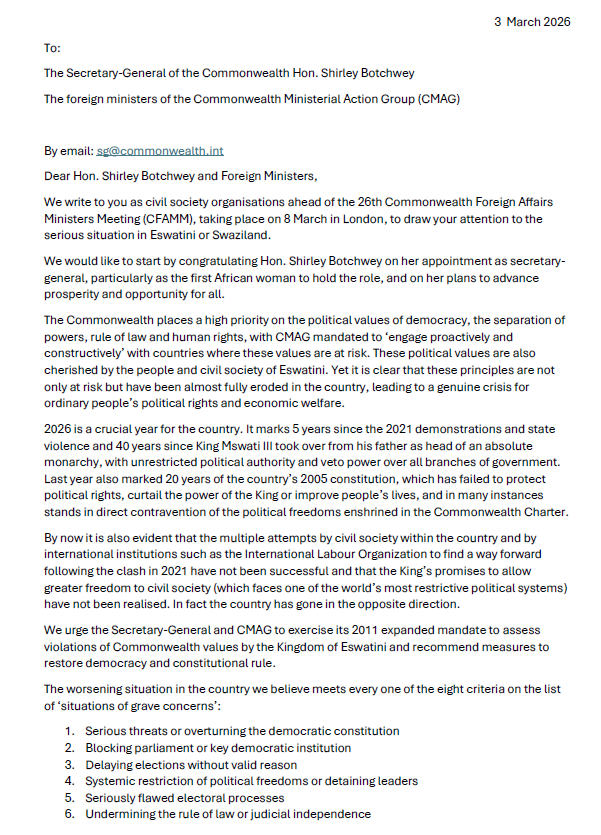
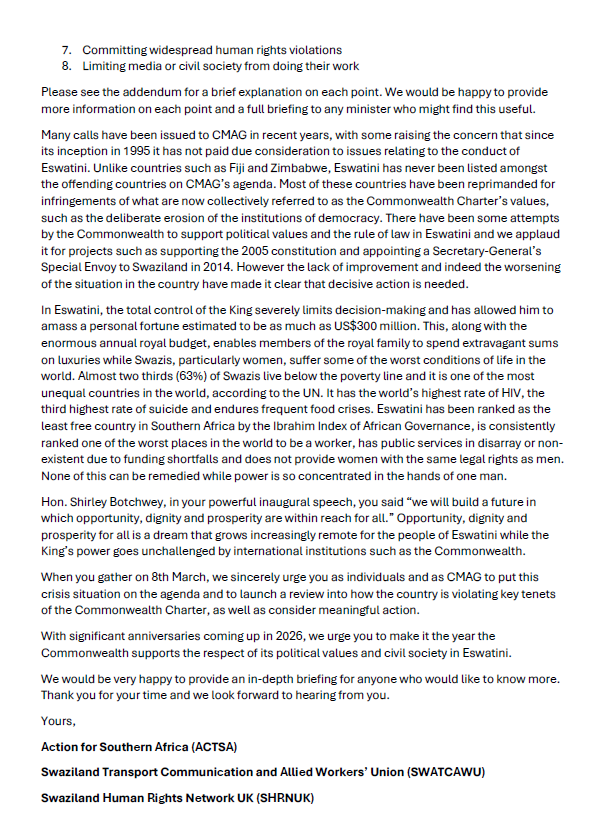
On 3rd March 2026, ACTSA, the Swaziland Human Rights Network UK (SHRNUK) and the Swaziland Transport Communication and Allied Workers’ Union (SWATCAWU) wrote to the Commonwealth Ministerial Action Group (CMAG) urging it to put Swaziland on its agenda in a crucial year for democracy and human rights in the country.
In June 2021 massacre, waves of pro-democracy protests rocked the country amid anger at deteriorating human rights and lack of reforms, after the death of student Thabani Nkomonye. The police reacted with brutality, killing at least 46 unarmed pro-democracy activists and bystanders (including children), with hundreds more were wounded, disappeared or tortured. Read more in this Human Rights Watch report.
King Mswati III took over from his father 40 years ago in 1986 as head of the absolute monarchy, with unrestricted political authority and veto power over all branches of government. Swazis face one of the most restrictive political systems, with political parties banned, judicial executive and legislative powers consolidated in the hands of the monarch and opposition activities severely punished.
The King’s person fortune estimated to stand at around $300 million US dollars and the Government tens of millions of dollars annually for his upkeep, with him receiving an extra US$3 million in April ahead of his lavish jubilee celebrations.
Meanwhile, there is little for Swazis to celebrate. The economic situation in the country has been getting progressively worse. Almost two thirds (63%) live below the poverty line and it is one of the world’s most unequal countries. It has the world’s highest HIV rates, third-highest suicide rate and endures frequent food crises, while women are denied basic rights and face extremely high rates of gender-based violence. None of this can be remedied while power and wealth is so concentrated in the hands of one man.
CMAG’s role is to ‘engage proactively and constructively’ with member countries where Commonwealth political values – such as democracy, the separation of powers, and human rights – are at risk. Ahead of the 26th Commonwealth Foreign Affairs Ministers Meeting (CFAMM) ACTSA and SHNRUK urged the Commonwealth to take action on these principles being almost fully eroded in country, which has caused a political and economic crisis for Swazis.
The letter argued that the situation in Swaziland met every one of the eight criteria on the list of Commonwealth’s ‘situations of grave concerns’ with the case for each criteria outlined in an addendum.
The country also last year marked 20 years since the enshrining of 2005 constitution, which it is now clear has failed to protect political rights, curtail the power of the King or improve people’s lives, and in many instances stands in direct contravention of the political freedoms enshrined in the Commonwealth Charter.
Read the letter to CMAG here.